| TL;DR Two minutes of pick and pack at $20/hour is $0.67 a unit. Most FBM models enter zero.FBA generally wins under 1 lb and at speed. FBM generally wins on oversized and on anything selling under 1 unit a month.Switching to FBM can cost around 20% of unit volume through lost Prime eligibility. Model that before the fee saving.A 10% return rate changes the answer, because returns are handled differently and priced differently under each. Short version: FBA versus FBM is not a fee comparison, it is a comparison between a fee you pay and a cost you absorb, and the absorbed one does not appear on a statement. |
Run the comparison the way most sellers run it and FBM wins almost every time. That should be your first clue that the comparison is wrong.
It wins because one side of it is invoiced and the other is not. Amazon sends a bill for fulfillment. Nobody sends you a bill for the two hours you spent packing sixty orders on a Sunday, so the model records that as free, and free beats $3.22 every time.
The full cost model, with the inputs that belong on each side, is worked through in this FBA vs. FBM revenue calculator walkthrough. What follows is the input it is easiest to enter as zero.
Your Own Time Has a Price
Two minutes per order, at $20 an hour, is 67 cents a unit. Add roughly 30 cents for the box and you are at a dollar before a carrier is involved.
That $20 is worth checking rather than assuming. The Bureau of Labor Statistics puts the median wage for hand laborers and material movers at $37,680 a year as of May 2024, which works out to $18.12 an hour, with the bottom ten percent under $29,780 and the top ten over $50,970. So $20 is slightly above the national median for the work, which is about right once you account for the fact that a real hourly cost includes payroll taxes and the employer’s share of everything else.
If you are packing the orders yourself, the number is still $20, or whatever your time is actually worth. Owner labor priced at zero is the single most common error in these comparisons, and it does not stop being a cost because nobody invoices you for it.
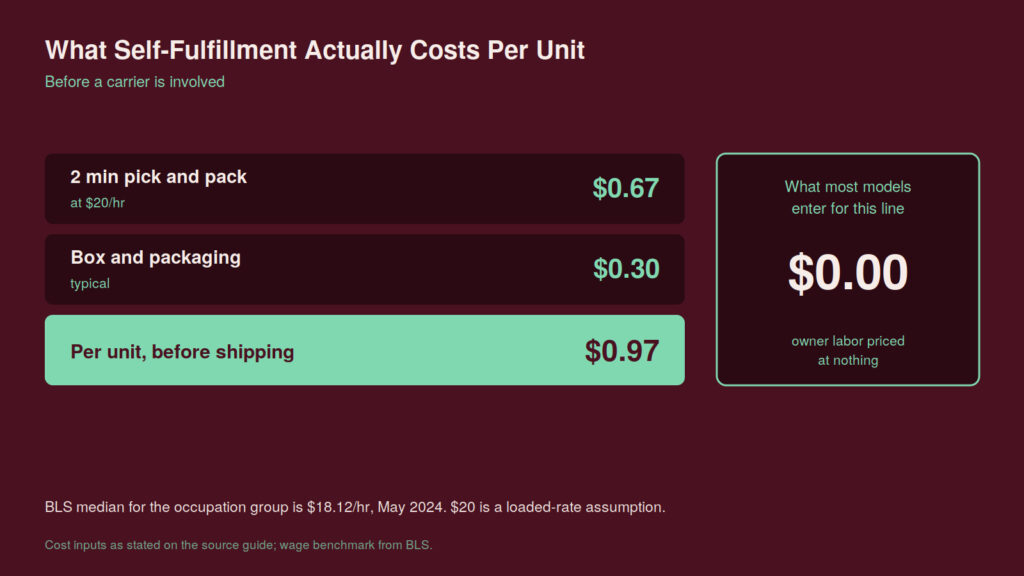
The cost is 97 cents before a carrier is involved. Most comparisons record it as nothing.
The Volume Question Cuts Both Ways
There are two thresholds and they point in opposite directions.
At around 50 sales a month, self-fulfillment is a manageable evening’s work. At 500, it is a job, and it is a job you are doing at 67 cents a unit against an alternative that costs a few dollars and requires nothing from you. Somewhere between those two the arithmetic stops being about money and starts being about whether you want to run a warehouse.
The other threshold runs the other way. A product selling under one unit a month is a storage problem, not a fulfillment problem. It will sit in a fulfillment center accruing monthly charges and eventually an aged-inventory surcharge, and no fulfillment efficiency recovers that. Slow inventory belongs at home.
The Twenty Percent Nobody Models
Here is the input that decides more of these comparisons than the fees do.
Moving a listing from FBA to FBM can cost roughly 20% of unit volume, because the listing loses Prime eligibility and the Buy Box behaves differently. That is a revenue effect, not a cost effect, and it will not show up anywhere in a fee comparison.
Twenty percent of volume is a much larger number than a couple of dollars a unit on the units you keep. A seller doing 300 units a month who saves $2 a unit and loses 60 units has saved $480 and lost the margin on 60 sales. Whether that trade is good depends entirely on the margin, which means the volume effect and the fee effect have to sit in the same model or the model is not answering the question.
Returns Change the Shape
A product with a 10% return rate is a different product under each arrangement.
Under FBA, returns are handled for you and charged for. Under FBM, they arrive at your address and consume the same labor as an outbound order, usually more, and the labor line that was 67 cents per outbound unit needs a second entry.
High-return categories are where self-fulfillment quietly falls apart, and the reason it is quiet is that returns are a lagging indicator. The first month of a launch looks fine. The month that includes the returns from the first month is the one that tells you.
The Matrix That Actually Decides It
Four inputs, and they answer it between them.
| Input | Points to FBA | Points to FBM |
| Unit weight | Under 1 lb | Oversized or heavy |
| Velocity | Fast-moving | Under 1 unit a month |
| Return rate | Around or above 10% | Low |
| Your available hours | Scarce | Genuinely spare |
The last row is the one that gets left out and it is not a soft consideration. It is a capacity constraint, and it is the reason sellers who chose FBM correctly at 50 units a month find themselves choosing again at 400.
Test the Thing You Cannot Control
One more input worth stress-testing before you commit: carrier rates.
Under FBM, shipping is your cost and your exposure. Run the model again with carrier rates 10% higher and see whether the answer survives. If a 10% rate increase flips the decision, you have not found a cheaper fulfillment method, you have found a cheaper fulfillment method on the condition that nothing changes.
Under FBA, that same variable is Amazon’s problem, which is a real part of what the fee buys and almost never appears on the comparison sheet.
Run It Per Product, Not Per Business
The mistake underneath all of this is treating fulfillment as a company-level decision. It is not. It is a product-level decision, and a catalog with thirty items can reasonably split thirty different ways.
Price the labor honestly, model the volume loss, and run it per SKU. The answer will be mixed, which is the correct answer, and the sellers who insist on one method for everything are usually subsidizing half their catalog with the other half.
About the Author