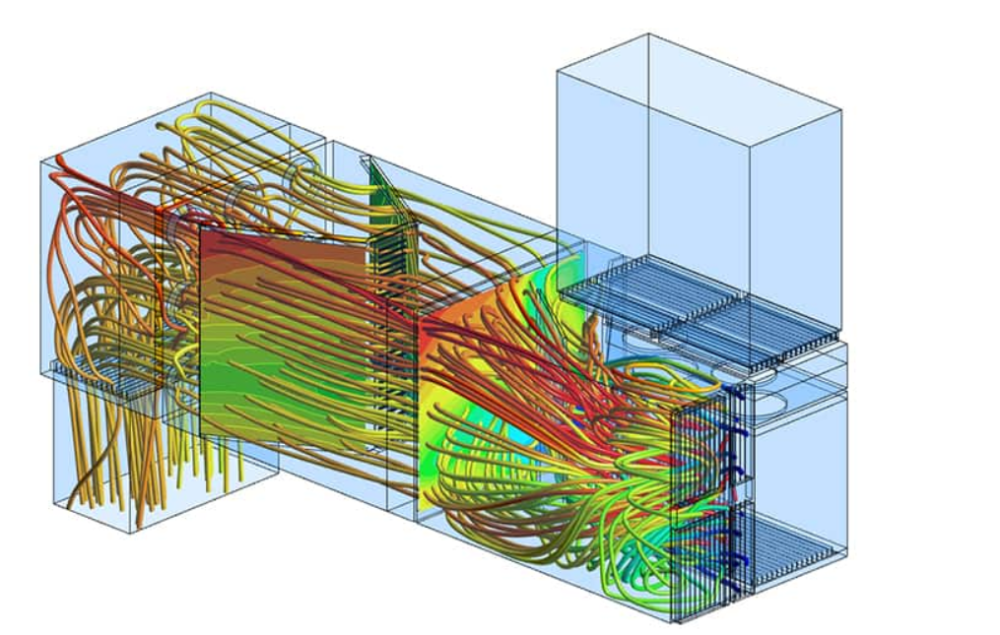
Computational Fluid Dynamics (CFD) is a specialized branch of fluid mechanics that uses numerical methods and advanced computing technologies to model, simulate, and analyze fluid flow behavior. By applying mathematical equations to liquids, gases, and plasmas, CFD enables engineers to solve complex fluid dynamics problems that would otherwise require extensive physical testing.
Today, Computational Fluid Dynamics plays a vital role in modern engineering applications, from analyzing airflow around aircraft and optimizing gas turbine performance to improving vehicle aerodynamics and reducing fuel consumption. Through virtual prototyping and simulation, CFD helps organizations accelerate product development, lower costs, improve efficiency, and enhance overall design quality.
In this article, we’ll explore Computational Fluid Dynamics in detail, including its applications, benefits, challenges, and the emerging technologies such as CFD software that are shaping the future of CFD.
What is Computational Fluid Dynamics?
Computational Fluid Dynamics uses numerical algorithms, mathematical models, and computational techniques to solve fluid flow and heat transfer problems. At its core, CFD solves the Navier-Stokes equations, which describe the motion of fluids while accounting for variables such as velocity, pressure, density, temperature, and viscosity.
Before CFD became widely available, engineers relied heavily on physical prototypes and experimental testing to evaluate fluid behavior. Modern CFD simulations have transformed this process by enabling accurate virtual analysis, significantly reducing development costs and accelerating innovation.
In addition to solving fluid flow equations, CFD incorporates advanced models for turbulence, multiphase flows, chemical reactions, mass transfer, and heat transfer. This versatility makes Computational Fluid Dynamics an essential tool for addressing complex engineering challenges across multiple industries.
The CFD Process: From Modeling to Simulation
CFD simulations typically follow a structured workflow consisting of several critical stages.
Pre-Processing
Geometry Definition
The first step involves creating an accurate digital representation of the physical system being analyzed. The quality of the geometry directly influences the accuracy of the simulation results.
Meshing
The geometry is divided into thousands or even millions of smaller computational cells. This process, known as meshing, enables numerical calculations to be performed throughout the fluid domain.
Solver Execution
Physics Setup
Engineers define fluid properties, boundary conditions, turbulence models, material characteristics, and initial operating conditions before beginning the simulation.
Numerical Solution
The CFD solver iteratively solves governing equations using advanced numerical methods until the solution reaches stability and convergence.
Post-Processing
Data Visualization
Simulation results are analyzed using visualization tools such as contour maps, streamlines, velocity vectors, pressure distributions, and temperature profiles. These insights help engineers understand fluid behavior and make informed design decisions.
The Importance of Meshing
Meshing is one of the most critical steps in Computational Fluid Dynamics. It involves dividing the simulation domain into smaller elements or cells that enable numerical calculations.
Advanced meshing techniques such as adaptive mesh refinement and boundary-layer meshing can significantly improve accuracy, particularly in areas with steep gradients, turbulence, or complex geometries.
Mesh quality directly impacts simulation precision. While finer meshes generally produce more accurate results, they also require greater computational power, memory capacity, and processing time. Engineers must carefully balance mesh resolution and computational efficiency to achieve reliable outcomes.
The Importance of Convergence
Convergence refers to the process by which CFD calculations stabilize and produce consistent results during iterative solution procedures.
A converged solution indicates that the governing fluid flow equations have been accurately solved and that the simulation results can be trusted for engineering analysis and decision-making.
Engineers typically monitor convergence using residual values, mass balance checks, force coefficients, and other physical parameters to ensure simulation accuracy and reliability.
Simply put, convergence occurs when further calculations no longer produce meaningful changes in the solution, indicating that the simulation has reached a stable and dependable result.
Advantages and Disadvantages of CFD
Computational Fluid Dynamics offers numerous benefits that make it an indispensable engineering tool.
Advantages
Cost Savings
Virtual prototyping significantly reduces the need for expensive physical testing, helping organizations lower development costs.
High Accuracy
CFD provides detailed insights into fluid behavior, allowing engineers to evaluate performance under a wide range of operating conditions.
Early Problem Detection
Design flaws and performance issues can be identified early in the development process, reducing costly redesigns and delays.
Faster Innovation
CFD enables rapid iteration and optimization, helping engineers bring products to market more quickly.
Disadvantages
High Computational Requirements
Complex simulations often require powerful computing resources, especially when high-resolution meshes and advanced physics models are involved.
Expertise Requirements
Accurate CFD analysis depends on a strong understanding of fluid mechanics, numerical methods, simulation setup, and result interpretation.
Validation Needs
Simulation results frequently require experimental validation to ensure reliability and accuracy for critical engineering applications.
Industry-Specific Applications
Computational Fluid Dynamics is widely used across numerous industries to improve performance, efficiency, and safety.
Aerospace
CFD helps optimize aerodynamic performance, improve fuel efficiency, predict high-speed airflow behavior, and enhance propulsion system design.
Automotive
Engineers use CFD to reduce aerodynamic drag, improve vehicle stability, optimize cooling systems, and increase fuel economy.
HVAC
Heating, ventilation, and air conditioning systems benefit from CFD through improved airflow management, energy efficiency, and occupant comfort.
Biomedical Engineering
CFD supports the development of medical devices, cardiovascular implants, respiratory systems, and blood flow simulations for healthcare applications.
Electronics
Thermal management simulations help improve heat dissipation, reliability, and performance in electronic devices and systems.
Oil and Gas
CFD assists in modeling multiphase flows, pipeline transport, erosion prediction, safety analysis, and process optimization.
Emerging Technologies and CFD
New technologies are expanding the capabilities and accessibility of Computational Fluid Dynamics.
Artificial Intelligence and Machine Learning
Artificial intelligence and machine learning algorithms are enhancing CFD by improving predictive accuracy, accelerating simulations, automating optimization processes, and leveraging historical simulation data.
Digital Twin Technology
Digital twins create virtual replicas of physical systems, enabling real-time monitoring, analysis, performance prediction, and continuous optimization.
High-Performance Computing and Cloud Computing
Advancements in high-performance computing and cloud-based infrastructure allow engineers to run larger, more detailed simulations with greater speed and cost efficiency.
Real-World Case Studies
Computational Fluid Dynamics has delivered measurable improvements across a variety of engineering disciplines.
Automotive Applications
CFD has helped vehicle manufacturers reduce aerodynamic drag, resulting in improved fuel efficiency and overall vehicle performance.
Aerospace Applications
Engineers have optimized aircraft wing designs and engine combustion processes through CFD simulations, leading to significant efficiency improvements.
Healthcare Applications
Medical device developers use CFD to enhance inhalers, cardiovascular devices, and respiratory systems, improving treatment effectiveness and patient outcomes.
Environmental Engineering Applications
CFD enables accurate prediction of pollutant dispersion in air and water, helping organizations manage environmental risks and improve pollution control strategies.
Conclusion
Computational Fluid Dynamics has become a cornerstone of modern engineering, enabling organizations to reduce development costs, accelerate innovation, and improve product performance through advanced simulation technology.
By providing detailed insights into fluid flow, heat transfer, and complex physical phenomena, CFD helps engineers make better decisions throughout the design process. As technologies such as artificial intelligence, digital twins, cloud computing, and high-performance computing continue to evolve, the capabilities of Computational Fluid Dynamics will expand even further.
With its ability to solve increasingly complex engineering challenges, CFD will remain an essential tool for driving innovation, improving efficiency, and shaping the future of engineering across industries.
About the Author